
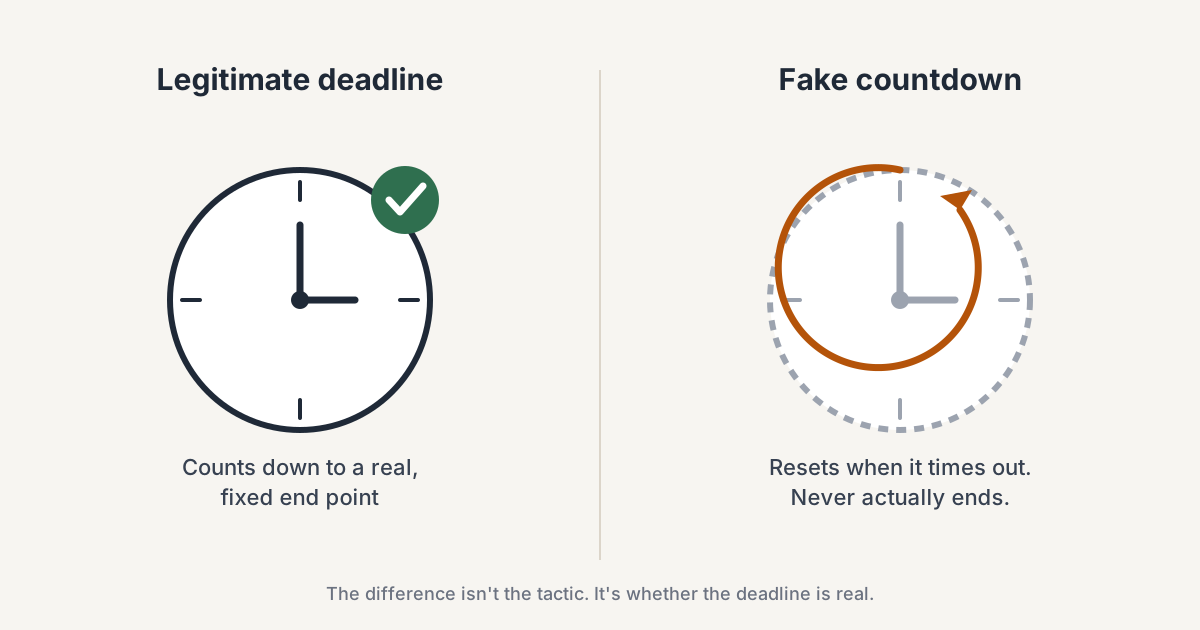
Every online shopper has seen a "Sale ends soon!" banner that's been sitting there, unchanged, for a month. At some point it stops working as urgency and starts working against you. Shoppers notice, and they remember. Limited-time offers can still be one of the more effective tools in ecommerce, but only when the deadline behind them is something that actually happens: a real window of time, or a real inventory limit that runs out on schedule.
That's the catch with urgency marketing. It converts precisely because it forces a decision, which is also why a fake deadline does more damage than no deadline at all. Catch one countdown that quietly resets, or one "limited-time" sale that's still running a month later, and a shopper starts questioning every deadline you show them after that, honest ones included. What separates a legitimate limited-time offer from fake scarcity comes down to one thing: whether the deadline is real.
What Is a Limited-Time Offer?
A limited-time offer is a discount, deal, or incentive that's only available for a defined, bounded window — a specific number of hours, a specific date range, or until a fixed inventory runs out. What actually does the work here is the deadline, not the discount. A 15% discount with no expiration is just a price. Attach "ends Friday at midnight" to that same 15%, and it turns into a decision the shopper has to make now instead of "later." And "later" is where most abandoned carts and closed tabs come from.
Limited-Time Offer Examples in Ecommerce
The mechanics repeat across the industry in a handful of formats. These are illustrative, hypothetical scenarios — not case studies or reported results — meant to show what each format looks like in practice:
- Flash sale. A home-goods store runs a 6-hour flash sale on a Tuesday afternoon — a historically slow shopping window — offering 20% off one category, announced through a single email and an on-site banner that disappears the moment the 6 hours are up.
- Seasonal countdown. A skincare brand's Black Friday countdown works because the calendar itself supplies the deadline: the sale is genuinely tied to a date that ends, not a banner that quietly resets into December.
- Free-shipping deadline. An apparel store offers free shipping on orders placed in the next 2 hours, timed to that day's actual warehouse pickup cutoff. The deadline maps to something operationally real, not a marketing trick.
- Pre-order window. A gadget brand opens pre-orders at a discount before the official launch date, with the incentive disappearing the moment the product actually ships.
- Post-interaction coupon. A visitor plays a short on-site game and wins a coupon, then sees a countdown for how long that specific coupon stays valid — say, 30 minutes — rather than a generic site-wide timer. The urgency attaches to something the visitor just did, not to every visitor who lands on the homepage.
That last format behaves differently from the rest. The shopper already did something to earn the offer, so the countdown is reinforcing a choice they already made instead of pushing them toward one they haven't.
Why FOMO and Urgency Work — and Where They Break Down
FOMO — the fear of missing out — is what turns "I might buy this eventually" into "I need to decide now." A deadline forces a decision point that wouldn't otherwise exist. That's really the whole value of urgency marketing — not persuasion, just a forcing function that removes the option to wait.
But that only works while the visitor believes the clock is real. A countdown that resets every time the page reloads, or a "flash sale" that's been running for six weeks, teaches the shopper the deadline is decorative. And once they've learned that, the next campaign gets ignored too, even if it's genuinely time-limited this time.
That's part of why the post-interaction coupon example above tends to hold up better than a cold banner on a landing page. The shopper already did something to earn it, so the clock isn't asking them to want something new. It's just reminding them what they've already got is about to expire.
Legitimate Urgency vs. Fake Scarcity
This is a part most ecommerce guides only touch on briefly, if at all, and it's not just an ethics question. It's a regulatory one. The FTC's September 2022 staff report, Bringing Dark Patterns to Light, names specific patterns in this territory, under FTC Act Section 5's general prohibition on unfair or deceptive practices:
- "Baseless Countdown Timer" — a countdown clock that pressures a shopper to buy immediately but, in the report's own words, "just goes away or resets when it times out," instead of counting down to a deadline that's actually real.
- "Demand claim" — a message implying demand is higher than it actually is. The report's own example: "20 other shoppers have this item in their cart."
None of this means urgency is off the table for merchants. It means the urgency you show has to actually exist. A countdown that always matches a real, bounded offer is a legitimate conversion tool, full stop. One that resets, or never quite corresponds to a real deadline, is the exact pattern described above, and it costs you trust whether or not anyone from the FTC ever notices.
How to Implement a Limited-Time Offer Without Losing Trust
- Set the deadline to something real before you set up the display. Decide the actual end date/time or the actual inventory cap first. The display should describe that decision, not invent one.
- Pair urgency with the right moment, not every moment. In Popconvert, display timing is controlled through triggers — Exit Intent, Time on page, Pages Visited, Scroll, or a specific HTML event/CSS selector. The documented best practice is to use only 1-2 triggers per campaign; stacking several at once tends to make a campaign under-display rather than reinforce the message.
- If the offer is a coupon a visitor earns through interaction, keep its display and its real validity in sync. Popconvert's FOMO Bar is built for exactly this case: it appears after a visitor completes an interactive campaign and won a reward, showing how much time is left to use it. That countdown is set manually by the merchant in the campaign's Design settings. It isn't automatically wired to a live expiration clock. Its honesty depends entirely on matching it to the real validity of the coupon configured in Rewards.
- Don't stack urgency permanently. If every visitor sees a countdown, it stops feeling like an exception and starts feeling like wallpaper. Reserve it for genuine campaigns and dates, not as a default site-wide state.
Common Mistakes to Avoid
- Deadline drift. A "24-hour sale" that's still live three days later is the single fastest way to train customers to ignore future deadlines.
- Fake scarcity counters. Static or randomized "X people are viewing this" or "only X left" widgets that don't reflect real inventory or real traffic. This is precisely what the FTC's dark-patterns report targets.
- Showing urgency to the wrong audience. A countdown aimed at someone who already redeemed the offer, or a loyal returning customer who doesn't need the nudge, just looks like a bug.
- Too many triggers competing for the same moment. Showing a popup on exit intent and on a timer and on scroll simultaneously usually suppresses the campaign rather than reinforcing it.
Where Popconvert Fits In
The mechanism above — a countdown that follows an interaction instead of greeting every visitor by default — is literally how Popconvert's FOMO Bar works: it appears after a visitor completes a campaign and wins a coupon, showing how much time is left to use it. The triggers that decide when the campaign itself appears (Exit Intent, time on page, pages visited, scroll, or a custom HTML event) let a merchant target a real moment instead of showing a popup to every visitor by default. The one thing this setup asks of the merchant: the FOMO Bar's countdown is configured manually, not synced to a live clock, so it only stays legitimate if it's set to match the actual validity of the coupon configured in Rewards.
Conclusion
Whatever format you use, the deadline only does its job if it's true. The examples, the FTC's own definition of where urgency crosses the line, the implementation details — all of it comes back to that one requirement.
Want to see how a merchant-configured, interaction-based countdown works in practice? Check out Popconvert's plans or create a free account to set up your first campaign.
FAQ
Is a countdown timer the same thing as a limited-time offer?
No. The countdown is just the display element. The offer is only genuinely "limited-time" if there's a real, defined end condition (a date, a time, or an inventory cap) behind it. A countdown with nothing real behind it is the "Baseless Countdown Timer" pattern the FTC has flagged, not a limited-time offer.
How long should a limited-time offer's window actually be?
There's no universal number. It depends on the format. A flash sale commonly runs a few hours to a couple of days; a seasonal campaign runs as long as the calendar event itself does. What matters more than the exact length is that the window is fixed before the campaign launches and never quietly extended once it's live — a deadline that moves isn't a deadline.
What if my store doesn't have a natural deadline like Black Friday or limited stock?
Create one deliberately and disclose it honestly. A specific, announced promotion window — a set number of days, decided in advance and not extended — works the same way a calendar event does. A coupon a visitor earns through an interactive campaign, valid for a short, clearly stated window after they win it, is another way to create a genuine deadline without needing a seasonal excuse.