
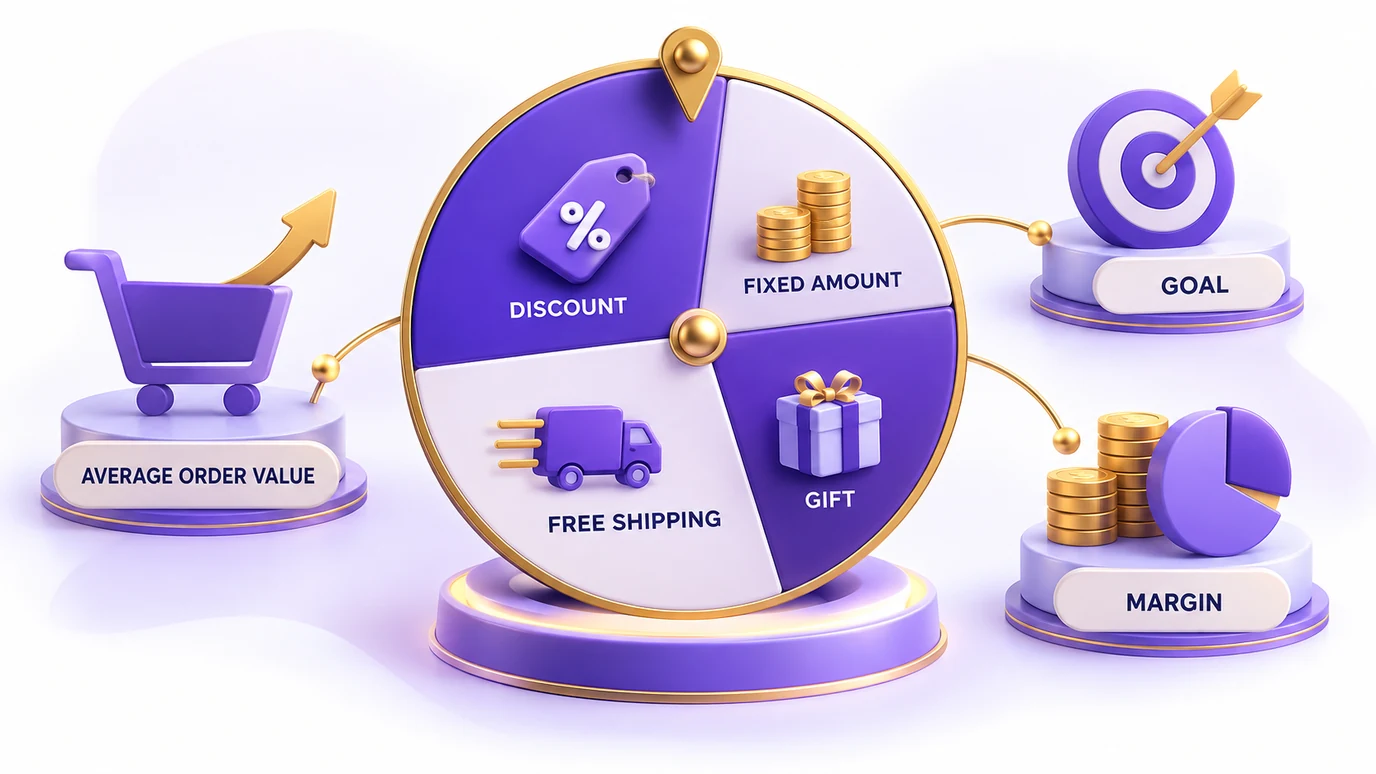
You can't just add four random discounts and expect the wheel to do the rest. The reward needs to make sense for your business, average order value, campaign goal and, most importantly, the margin you are willing to give up.
That is what this calculator is for. Enter your store category, average order value, campaign goal and current first-purchase discount. The calculator suggests a four-prize structure and assigns a probability to each reward. Use the result as a starting point, not as a ready-made pricing decision.
How to choose spin wheel prizes
The first mistake is thinking only about percentages. A spin wheel can offer different types of rewards:
- percentage discounts;
- fixed-amount discounts;
- free shipping;
- gifts;
- discounts on a future order;
- cashback;
- rewards with a minimum order requirement;
- offers limited to specific products or categories.
The right combination depends on what the campaign is trying to achieve.
A fashion store may naturally use percentage discounts. An electronics store may prefer a fixed amount with a minimum order. A business with expensive shipping may find free shipping more compelling, or more expensive, than a percentage discount.
So the question should not simply be “how much discount can I give?” It should be: “what benefit is meaningful to the shopper and still makes economic sense for my store?”
Define the coupon rules first
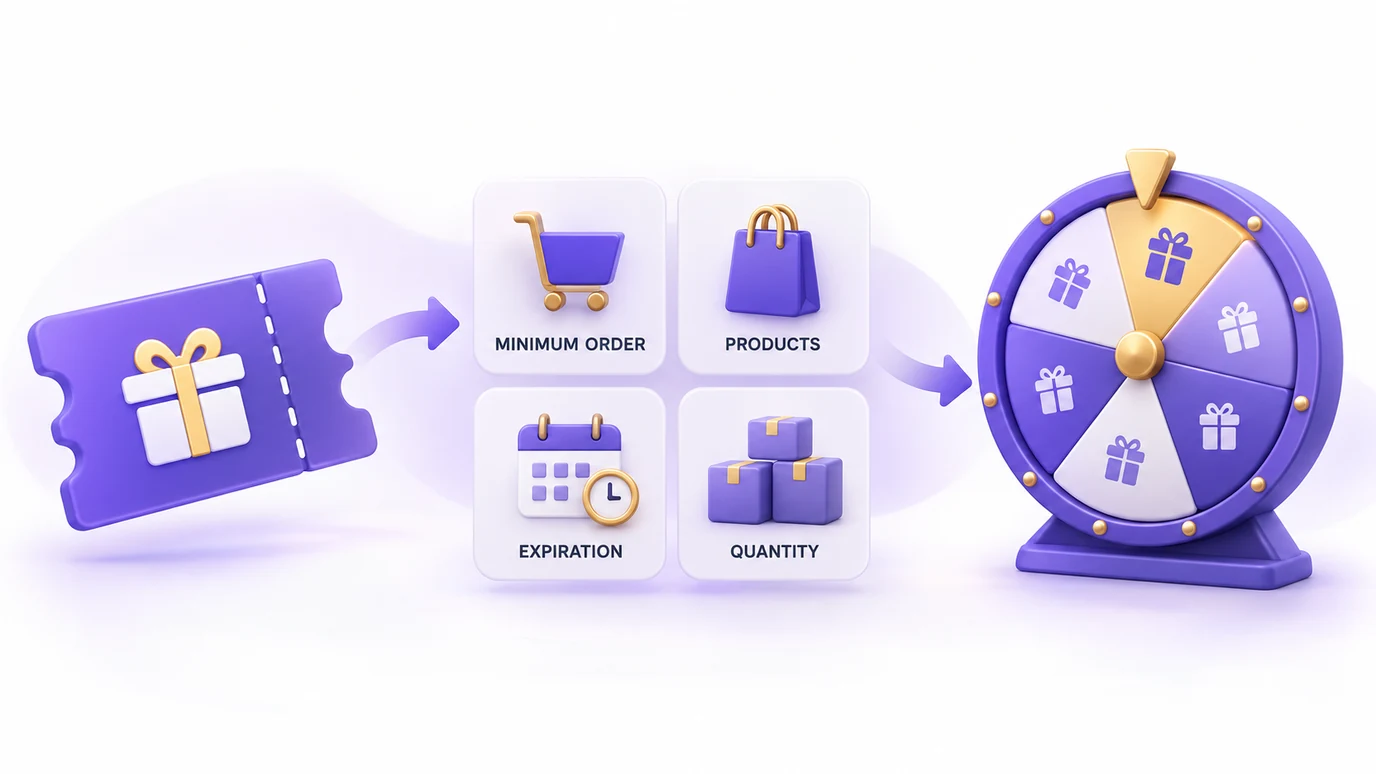
The wheel is not where the coupon is created. The coupon is normally configured in the ecommerce platform, and the platform determines which discount types and rules are available. Depending on the platform, a discount can include:
- start and end dates;
- minimum order values;
- eligible products or collections;
- minimum item quantities;
- usage limits;
- customer eligibility;
- discount combination rules;
- specific shipping conditions.
For example, Shopify documents discount codes with active dates, usage limits, minimum purchase amounts, product or collection eligibility and combination rules. That means the coupon strategy should be defined before the code is added to the wheel.
If your products have very different margins, one discount across the entire catalog may not make sense. If you want to move a specific category, the reward can be limited to that category. If the goal is to increase order value, a minimum-order reward may make more sense than simply increasing the discount percentage.
Don't make every prize the smallest discount
A wheel needs a reason to be spun. If every option looks weak, the shopper has little to look forward to. But putting large discounts on every segment can create a margin problem.
A stronger structure is to combine different rewards with different probabilities. For example, you can have:
- a common, lower-cost reward;
- a mid-level reward;
- a more attractive reward;
- a higher-value reward with a lower probability.
The principle is straightforward: the more expensive the reward is for the store, the more carefully its frequency should be controlled. Probability is therefore part of the campaign economics, not just a visual setting.
The top prize still needs to be attractive
Imagine a wheel where every reward is almost identical. There is little difference between winning one segment and another. Now imagine a wheel with one clearly more attractive reward. It can have a lower probability and still serve an important purpose: giving shoppers a reason to spin.
That does not mean the top prize has to be a huge discount. It could be:
- free shipping;
- a gift;
- a larger discount on a specific category;
- a higher fixed-value reward above a minimum order;
- a benefit for the next purchase;
- cashback;
- another benefit with meaningful perceived value.
The most attractive prize still needs to be economically acceptable for the store.
Average order value changes the prize size
The same discount does not cost the same across stores. A 10% discount on a $50 order is very different from 10% on a $500 order. That is why average order value is one of the calculator inputs.
For higher-value orders, a percentage discount can create a much larger absolute cost. In some businesses, a fixed amount combined with a minimum order may therefore be easier to control. The opposite can also happen: a small fixed reward may feel insignificant when products have a high average order value. The calculator is designed to avoid choosing a reward based on one number alone.
Use rules to protect the economics of the promotion
A coupon does not have to apply to every order. Rules can control where and when the benefit applies.
Minimum order
“$20 off orders over $200.” The reward is tied to a minimum purchase.
Specific products or categories
“15% off selected products.” This concentrates the promotion where it makes commercial sense.
Minimum quantity
“Buy 3 items and get the reward.” This can support campaigns focused on increasing item count.
Expiration
The reward can have a defined redemption window.
Next purchase
Instead of discounting the current order, the reward can encourage a future purchase.
Free shipping with conditions
Free shipping can also have rules. Shopify, for example, supports minimum purchase requirements and the option to exclude shipping rates over a certain amount. The right rule depends on the campaign and business model.
Different store categories can call for different prizes
Product category matters, which is why the calculator uses your store segment as an input. Some categories naturally lend themselves to percentage discounts, while others may be easier to control with fixed amounts. Beauty and wellness stores may use gifts or samples alongside discounts. Jewelry or higher-ticket stores may use fixed rewards or free shipping instead of a large percentage discount.
These are starting structures, not universal rules. Your actual margins, acquisition costs, inventory and commercial policy matter more than any automated recommendation.
If the goal is higher order value, make the coupon conditional
There is a difference between “Get $20 off” and “Get $20 off orders over $200.” The second offer creates a condition around the purchase, which can be useful when increasing order value is the campaign goal.
The same principle can be applied to specific products or categories. If inventory needs to move faster, the reward can be restricted to selected products instead of being applied across the store. The reward becomes part of the merchandising strategy rather than simply a generic discount.
Lead capture and purchase conversion are not the same objective
Not every wheel needs to optimize for an immediate purchase. In a lead-generation campaign, the main goal may be capturing the visitor's contact information. In that case, the reward structure can be more conservative because the campaign is primarily acquiring a contact. In a campaign designed to turn a visit into a purchase, the attractiveness of the reward may matter more.
Start by deciding what behavior you want the campaign to encourage. Then choose the reward.
You can use different wheels for different contexts
A store does not necessarily need one offer for every visitor. A paid campaign may send traffic to a specific category, a promotion may lead to a collection, and a campaign URL may have its own offer. In those situations, a different wheel can make sense when the visitor context and commercial strategy are genuinely different.
But segmentation for its own sake does not help. Create a different experience when there is a real strategic reason to do so.
The calculator does not know your margins
This is the most important limitation. The calculator considers store category, average order value, campaign goal and other inputs, and produces a conservative starting recommendation. But it does not know:
- your product margins;
- customer acquisition cost;
- shipping cost;
- inventory position;
- commercial policy;
- competitors;
- which products you actually want to promote;
- which discounts you already offer elsewhere.
So do not treat the output as the “correct” discount. Treat it as a first structure to evaluate. Before publishing the coupons, check whether each reward makes sense for the products it applies to and whether the maximum campaign cost fits your commercial strategy.
How to use the calculator
Enter:
- store category;
- average order value;
- campaign goal;
- whether you already offer a first-purchase discount;
- the current discount amount, when applicable.
The calculator returns four suggested prizes and their probabilities, designed as a conservative starting point. You can copy the reward text and use the structure when creating the actual coupons in your ecommerce platform. The codes, rules, expiration, eligible products and other conditions still need to be configured according to your platform and business strategy. For the reasoning behind the prize types, read the article spin-the-wheel prize ideas.
Use the wheel as part of the strategy
A good wheel starts before the wheel. Start with: what do I want this visitor to do? Then: what benefit makes that action more attractive? And finally: what is the highest-value benefit my business can afford without damaging the economics of the campaign?
The calculator helps with that second part: it gives you a structure to start evaluating. The final decision remains with the store.
Spin wheel prize FAQ
What should I put on the slices of a discount wheel?
On a discount wheel, the slices can hold a percentage discount, a fixed-amount discount, free shipping, a gift or a benefit for the next purchase. The right mix depends on your store category, average order value, campaign goal and margin. The spin wheel prize calculator suggests four prizes as a starting point.
What prizes should I offer on an ecommerce spin wheel?
On an ecommerce spin wheel, it helps to combine different prize types: a small percentage discount, a fixed-amount discount with a minimum order, free shipping and a gift. The mix varies by store category and margin. The calculator builds that mix from your category, average order value and goal.
What discounts should I offer on a spin-to-win wheel?
On a spin-to-win wheel, mix a more common, cheaper discount with more attractive, rarer ones. The percentage or amount depends on average order value and margin: in tight-margin categories such as electronics and auto parts, the calculator's suggestions stay at single-digit percentages.
What gifts or freebies can I offer on a discount wheel?
On a discount wheel, a gift can be a sample, an accessory or a low-cost item with perceived value. The calculator suggests a free sample for categories such as beauty and health, and a free gift for categories such as sports, pet, baby and toys. The cost of the gift has to fit the campaign margin.
What discount should I give on a prize wheel for my online store?
There is no universal discount for a prize wheel. It depends on average order value, margin and eligible products. The spin wheel prize calculator's suggestions generally fall between 3% and 15%, depending on category and order value, and should be treated as a starting point.
How many slices should a discount wheel have?
The spin wheel prize calculator works with four prizes, which gives variety without creating an offer that is hard to manage. Wheels with more slices tend to repeat or vary prizes; what matters is that the expected cost of all slices fits the campaign.
How do I set the odds of each prize on a discount wheel?
On a discount wheel, the prizes that cost the store more should have lower odds, and cheaper prizes should come up more often. The calculator suggests 40%, 30%, 20% and 10% for the four prizes (45%, 25%, 20% and 10% when the goal is lead capture). It is a conservative starting distribution, not a rule.
What are the best odds for each prize on a spin-to-win wheel?
There are no universal best odds on a spin-to-win wheel. They depend on the cost of each prize, your margin and the campaign goal. As a reference, the calculator uses 40%, 30%, 20% and 10%, giving the most valuable prize the lowest chance.
Is free shipping a good prize for a discount wheel?
It depends on the business. On a discount wheel, free shipping can be very attractive, but it can also be expensive when the store's shipping cost is high. The calculator suggests free shipping, with or without a minimum order, in several categories; check your shipping cost before offering it.
Should a discount wheel include a no-prize or try-again slice?
The spin wheel prize calculator does not include a no-prize slice: it always suggests four prizes. An empty slice lowers campaign cost, but it is an experience decision, because visitors spin expecting to win something. If you use one, consider how it affects the visitor's perception.
How do I calculate the prizes for a discount wheel?
To calculate discount wheel prizes, consider your store category, average order value, campaign goal, reward type and coupon rules. The calculator combines those inputs and suggests four prizes with the chance of each. Then check every prize against your margin.
How do I choose discount wheel prizes based on average order value?
Average order value sizes the prize on a discount wheel: the same percentage costs more on larger orders. For high order values, a fixed amount with a minimum order is usually easier to control; for low ones, a small fixed amount can feel irrelevant. The calculator adjusts amounts and minimum orders by order-value range.
How do I create a discount wheel for my ecommerce store?
To create a discount wheel for an online store, first define the prizes and the rules of each benefit. Then create the coupons in your ecommerce platform and use the codes in the wheel tool. The prize calculator helps with the first part; the exact setup depends on the platform.
What first-purchase discount should a spin-to-win wheel offer?
The first-purchase discount on a spin-to-win wheel should respect your margin and what the store already offers. If you tell the calculator you already give a similar first-order discount, it swaps that prize for another type, such as free shipping or a gift, and avoids percentages far above the current discount.
How do I avoid losing margin with a discount wheel?
To avoid losing margin with a discount wheel, avoid large discounts on every slice, give lower odds to the costliest prizes, use a minimum order and restrict the benefit to products or categories. Before publishing, add up the maximum campaign cost and compare it with your margin.
Can I use a discount wheel to collect leads?
Yes. A discount wheel can aim at capturing the visitor's contact, and in that case the prize mix can be more conservative because the main gain is the contact. The calculator has a lead generation goal that adjusts the probability distribution.
What prize should a discount wheel offer to increase average order value?
To raise average order value with a discount wheel, use prizes tied to a minimum order, such as a fixed amount above a given purchase value. The benefit creates a condition for the purchase. The calculator has an increase average order value goal that builds prizes with a minimum order.
What prize should a discount wheel offer to clear inventory?
To clear inventory with a discount wheel, restrict the prizes to selected items or categories instead of applying the discount across the store. The calculator has a clear specific inventory goal that builds prizes applied to selected items.
What prize should a discount wheel offer to bring customers back?
To bring customers back with a discount wheel, offer benefits for the next order, such as a discount on the next purchase, free shipping or early access to a collection. The calculator has a retention / next purchase goal that builds prizes like these.
Spin wheel prize ideas for ecommerce: what can I offer customers?
On an ecommerce prize wheel, offer a mix of benefits that customers value and the store can afford: a percentage discount, a fixed amount with a minimum order, free shipping and a gift. The most attractive prize should be the rarest. The spin wheel prize calculator suggests that mix for your category.
Can the same discount wheel coupon apply to every product?
It depends on the store platform. Platforms such as Shopify let you restrict a discount code to specific products or collections, and set expiration, usage limits, minimum purchase and combination rules. On a discount wheel, decide this before registering the coupon.
Does a discount wheel need a minimum order?
It is not mandatory, but a minimum order is a useful rule on a discount wheel to protect margin and encourage larger orders. The calculator uses a minimum order on several fixed-amount prizes and when the goal is to increase average order value.
Can cashback be a prize on a discount wheel?
It can, if the store or platform offers cashback. The spin wheel prize calculator does not suggest cashback; it works with percentage discounts, fixed amounts, free shipping, gifts, samples and early access. If you use cashback, treat its cost like any other prize.
How much does a discount wheel cost a store?
The cost of a discount wheel depends on which prizes exist, the odds of each, how many visitors spin and how many coupons are actually used. The calculator does not estimate that cost because it does not know your margin; add up the maximum campaign cost before publishing.
Is the spin wheel prize calculator free?
Yes. The spin wheel prize calculator is free and works without a login or registration.
Is the data I enter in the spin wheel prize calculator sent to a server?
No. The spin wheel prize calculator runs in your browser, and your answers are not sent to a Popconvert server.
Where Popconvert fits
Popconvert can be used for the gamified experience. When the reward is a coupon, the store creates the benefit in its ecommerce platform and adds the coupons in Popconvert's Rewards area. The platform includes a Discount Wheel among its gamified experiences.
The commercial logic remains with the store: what benefit, for whom, in what context, under what condition. The wheel turns that offer into an interactive experience.