
So you added a spin-the-wheel pop-up to your ecommerce store.
Now comes the question almost every store owner eventually asks:
What should I put on the wheel?
Use the free calculator below to get a conservative starting prize mix based on your store's vertical, average order value, campaign goal and existing first-order discount.
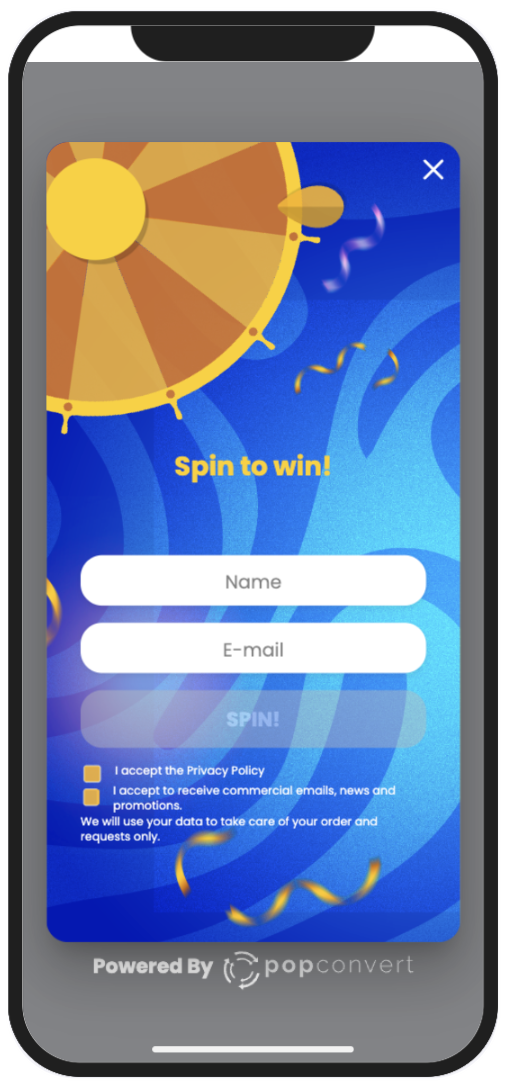
Should it be 10% off? $10 off? Free shipping? A gift? A bigger discount with a lower chance of winning?
There is no single coupon that converts best for every store.
The right prize depends on what you are trying to achieve, your average order value, your margins, your products, your inventory and the kind of promotion you are running.
A fashion store selling $50 products should not necessarily use the same rewards as a furniture store selling $2,000 products. And a wheel designed to generate first orders does not need the same prizes as one designed to reward existing customers after a purchase.
The good news is that you don't need to guess — the calculator above already gave you a starting point. The sections below walk through the reasoning, ten practical prize ideas, and how to balance a mix on your own.
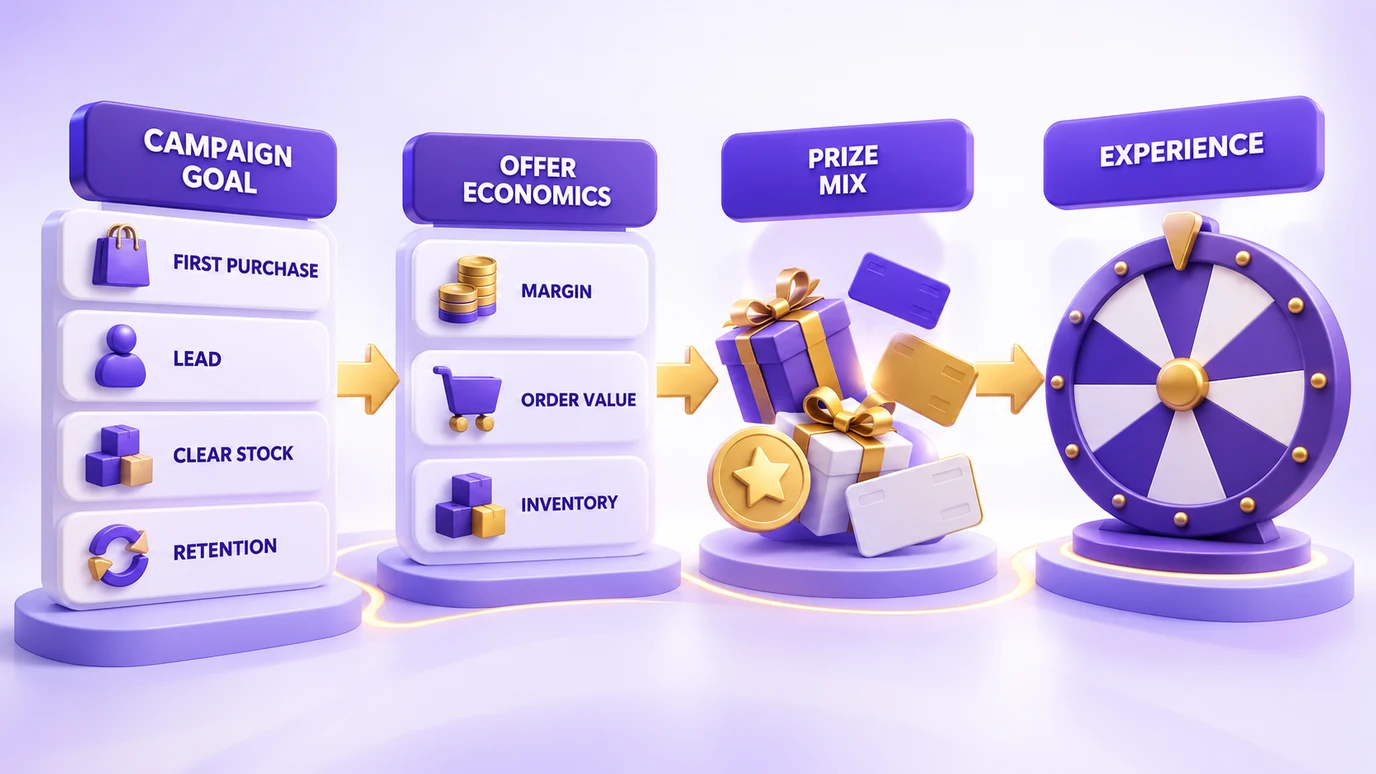
Start With the Campaign, Not the Coupon
The biggest mistake is starting with:
What discount should I put on my wheel?
Start with:
What am I trying to achieve with this campaign?
The prize is part of the strategy, not the strategy itself.
For example:
- Generate first orders: offer a reward that can be used immediately.
- Increase average order value: use a discount tied to a minimum order value.
- Move excess inventory: promote a specific product or category.
- Increase email signups: make the wheel attractive enough to motivate visitors to participate.
- Promote a new product: use a gift, sample or early-access reward.
- Increase repeat purchases: give existing customers a reward for their next order.
- Promote an in-store campaign: use a reward that can actually be redeemed in the physical store.
Your margins matter just as much.
A 10% discount on a $50 product and a 10% discount on a $2,000 product are very different promotions. In some categories, a fixed-value discount makes much more sense than a percentage.
Before choosing the prizes, look at:
- Your average order value
- Your product margins
- Your existing first-order discount
- Your previous promotional discounts
- Your inventory position
- Your competitors' current pricing
- The objective of the campaign
Only then should you decide what goes on the wheel.
The Basic Rule: Make the Wheel Attractive Without Making Every Prize Expensive
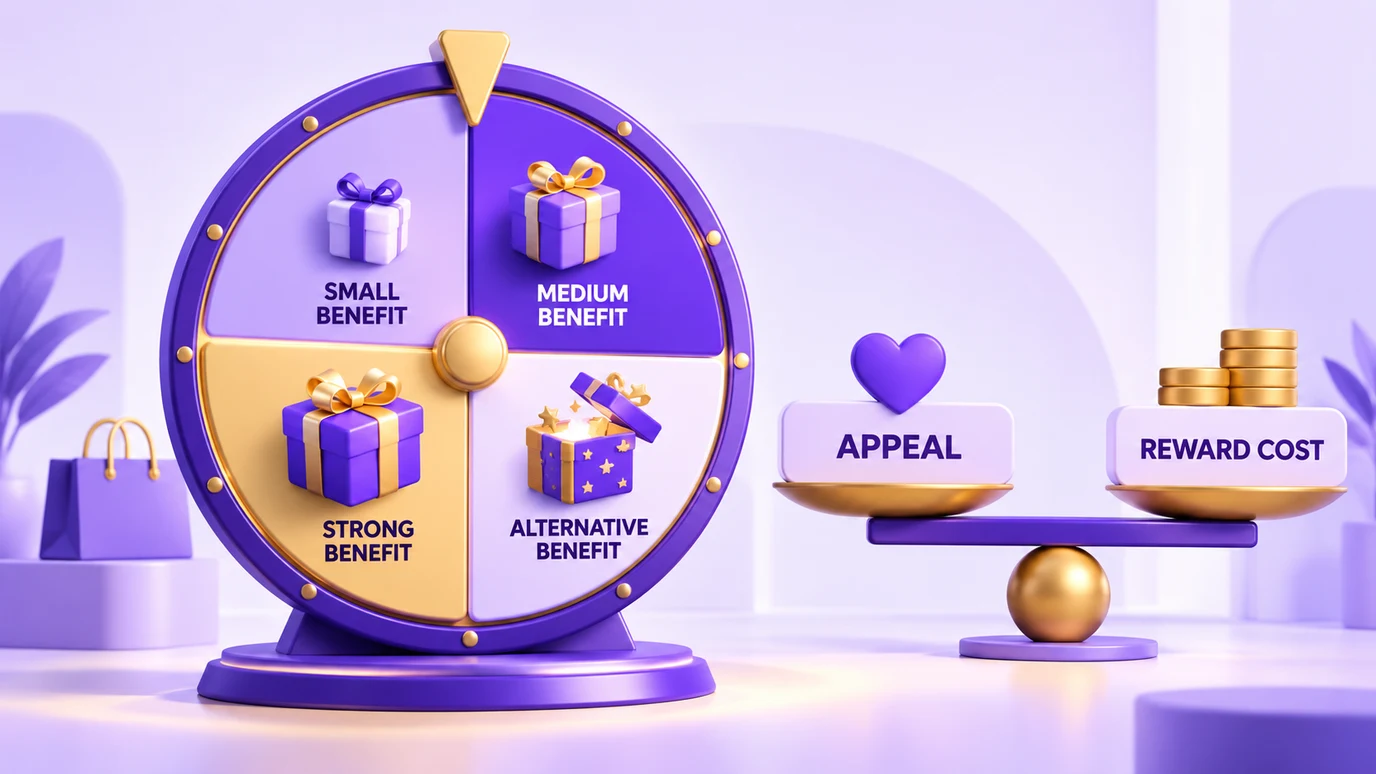
A good wheel usually has more than one type of outcome.
You might have four or more rewards with different levels of attractiveness:
| Prize | Example | Probability |
|---|---|---|
| Small discount | 5% off | High |
| Medium discount | 10% off | Medium |
| Strong discount | 15% off | Low |
| Extra benefit | Free shipping | Medium/Low |
The idea is simple:
Give shoppers a reason to spin without making your most expensive reward the most common outcome.
If your ecommerce platform and campaign setup allow different coupon types and probabilities, you can make your most attractive prize relatively rare while keeping the other prizes useful enough that winning still feels worthwhile.
This creates a useful balance:
Attractive prize → more motivation to participate → more leads → more opportunities to convert → controlled promotional cost.
But probability should never be used to hide an unreasonable offer. Every reward should still provide a real benefit, and every condition should be clear to the shopper.
If you want a starting point before reading further, the calculator near the top of this article turns your vertical, AOV, goal and existing discount into a four-prize mix.
10 Spin-the-Wheel Prize Ideas
Here are ten practical rewards you can use as starting points.
The important part is not to copy the percentages or dollar amounts blindly. Adapt them to your product economics.
1. A Percentage Discount for a First Purchase
A first-order discount is one of the simplest wheel rewards.
Examples: 5% off, 10% off, 15% off.
For many ecommerce stores, up to around 10% is a reasonable starting point for a first-purchase incentive, but the right number depends on your margin and category.
When it works. Use it when your main objective is turning a new visitor into a first customer, for example: "Spin to win 10% off your first order." The visitor gets an immediate benefit, while the store gets an opportunity to convert someone who might otherwise leave without buying.
What to watch. Percentage discounts become more expensive as the cart gets larger. If your wheel gives 15% off a $300 order, that is very different from giving 15% off a $50 order. Check your lowest-margin products before deciding on the maximum percentage.
2. A Discount Ladder
Instead of offering the same discount to everyone, create several possible rewards, such as 5%, 8%, 10% and 15% off. The larger rewards can have lower probabilities, giving shoppers something meaningful to hope for while letting the store control how frequently the most expensive reward is distributed.
| Reward | Example probability |
|---|---|
| 5% off | Higher |
| 8% off | Medium |
| 10% off | Lower |
| 15% off | Lowest |
The exact probabilities depend on your economics. The important principle is:
The more expensive the reward, the more carefully you should control how often it is awarded.
3. A Fixed-Value Discount
Percentage discounts are not always the best option. A fixed-value reward can make more sense when your products have a high average order value, for example: "$40 off orders over $500" or "$75 off orders over $1,000." This can be particularly useful for furniture, electronics, appliances and other categories where a percentage discount can quickly become expensive.
Why it can work. The customer sees a concrete benefit: "I just won $75." Meanwhile, the minimum order value protects the economics of the promotion. The key is to make sure the threshold is high enough to generate incremental revenue rather than simply discounting orders the customer would have placed anyway.
4. Free Shipping
Free shipping is another classic wheel reward. It can work particularly well when shipping is a visible cost during checkout, for example: "Spin and win Free Shipping on orders over $75."
But calculate the real cost. Free shipping is not automatically cheaper than a discount. A large or heavy order going to a distant destination can cost significantly more to ship than a small parcel. Before putting it on the wheel, understand your average shipping cost, your highest shipping costs, whether you can apply a minimum order, and whether the reward should apply to every destination. For some stores, free shipping will be more attractive than 10% off. For others, it may be substantially more expensive.
5. A Product or Category Discount
Your wheel does not necessarily need to discount the entire store. You can use the reward to push shoppers toward a specific product or category, for example: "15% off all winter jackets" or "$20 off your new arrivals." This can be especially useful when you have excess inventory, a slow-moving category, seasonal products, a new collection or products with healthier margins. The wheel becomes part of your merchandising strategy rather than just a generic acquisition tool.
6. A Minimum-Order Reward
If your goal is to increase average order value, don't necessarily give the customer an unrestricted discount. Instead, make the reward conditional, for example: "$20 off orders over $150" or "15% off orders over $200." The customer has to increase the value of the cart to use the reward.
This is particularly useful when your existing average order value is already known. If your average order is $100, a $20 reward with a $75 minimum may simply give away money. A $150 minimum may create a different incentive: "I'm already buying this. What can I add to reach the reward?" That's the behavior you want to test.
7. A Gift With Purchase
Not every prize needs to be a discount. You can offer a physical product instead, for example: "Spin to win an exclusive gift." This can be especially interesting when you have low-cost products, samples, accessories, excess inventory, or products with high perceived value but low unit cost. The customer may perceive the gift as more valuable than a small percentage discount, while your actual cost remains relatively low.
The important part. The gift is inventory. If you have 200 units available and your campaign distributes 500 winning rewards, you have a problem. Calculate how many rewards you can realistically fulfill before launching the campaign.
8. An Exclusive Product Sample
A sample can be a particularly useful prize when the objective is not only conversion but also product discovery. For example, a beauty brand could offer "Win a free sample of our new serum," a food brand could offer "Get a sample of our new flavor," and a coffee brand could offer "Try our new roast for free." The reward gives the customer a reason to engage with something they might not otherwise buy, and it can also turn the wheel into a cross-selling mechanism. The cost is not just the sample itself; consider packaging, shipping and fulfillment as well.
9. Early Access or Exclusive Access
A prize does not have to reduce the price. You can give shoppers something that money cannot necessarily buy, such as "Get early access to our next collection" or "Shop the new collection 24 hours before everyone else." This can work particularly well for brands with product drops, limited collections, seasonal launches or highly engaged customer communities. The value comes from exclusivity rather than discounting. Just make sure the access is real — if everyone gets the same access anyway, the prize loses its meaning.
10. A Reward for the Next Purchase
Not every wheel needs to be about the order happening right now. If your goal is retention, give the customer a reason to come back, for example: "$20 off your next order" or "15% off your next purchase, valid until October 31." This can work particularly well after a customer has already completed an order, turning the campaign into part of your retention strategy rather than customer acquisition.
You can also use non-monetary rewards, such as a free gift on the next order, free shipping on the next order, early access to a new collection, or an exclusive product. The important thing is to give the reward a clear expiration date so it creates a reason to return.
The Best Prize Depends on Your Ecommerce Vertical
There is no universal "best" wheel prize.
Your category changes what feels valuable to the customer and what makes financial sense for the store. Here is a useful starting point:
| Ecommerce vertical | Possible strategy | Example rewards |
|---|---|---|
| Fashion | Percentage discount + occasional larger reward | 5%, 8%, 10%, 15% |
| Beauty & Cosmetics | Discount + samples + gifts | 10% off, free sample, gift |
| Food & Beverage | Fixed value + free shipping + bundles | $10 off $75, free shipping |
| Furniture | Fixed-value discount + minimum order | $75 off $1,000 |
| Electronics | Fixed value or product-specific discount | $50 off selected products |
| Home & Decor | Category discount + minimum order | 10% off, $50 off $300 |
| Sports & Fitness | Percentage + product/category rewards | 10% off, free accessory |
| Subscriptions | Free trial + first-payment discount | 7-day trial, 15% off first month |
These are starting points, not rules.
A fashion store with 20% margins should not blindly copy the discount strategy of a fashion store with 60% margins. Your own economics come first.
What Should You Put on Your Wheel?
If you are still unsure, use this decision process.
If your goal is first-order conversion
Start with a percentage discount, a fixed-value discount, or possibly free shipping. Keep the reward immediately usable.
If your goal is increasing average order value
Consider a fixed value with a minimum order, a percentage with a minimum order, or bundle discounts. The reward should give the customer a reason to add something to the cart.
If your goal is moving inventory
Consider product-specific discounts, category discounts, bundles or gifts with purchase. The wheel can help direct demand toward the products you actually want to move.
If your goal is increasing repeat purchases
Consider next-order discounts, free shipping on the next order, gifts or exclusive access. The reward does not have to be redeemed immediately.
Don't Put Only One Prize on the Wheel
One of the advantages of a spin-the-wheel campaign is that you can combine several rewards. Instead of giving every visitor the same 10% off, you could create something like this:
| Reward | Role |
|---|---|
| 5% off | Common reward |
| 10% off | Attractive reward |
| 15% off | Strong reward |
| Free shipping | Alternative benefit |
| $50 off $300 | High-value reward |
This creates a more interesting experience for the shopper. And if your setup supports different probabilities for individual rewards, you can make the more expensive prizes less frequent.
The goal isn't to make the wheel difficult to win. The goal is to make winning feel valuable while keeping the expected promotional cost under control.
How to Set the Probability of Each Prize
This is where the strategy becomes more interesting.
Suppose you have a $10 discount and a $50 discount. If both have exactly the same probability, the $50 reward may cost your business far more than you intended. Instead, you might make $10 off a high probability, $20 off a medium probability, and $50 off a low probability.
The exact numbers should come from your economics. Think about the expected cost of the campaign, not only the value of the biggest prize. And don't make the most common reward so weak that winning feels pointless — a customer who spins the wheel and wins something genuinely useful is more likely to see the campaign as valuable.
You Can Also Use Different Wheels for Different Products
This is an opportunity that many ecommerce stores overlook.
You don't necessarily need one wheel for your entire website. If your ecommerce platform and coupon configuration allow it, you can create different campaigns for different parts of the store, for example:
- Homepage. 10% off your first order.
- Fashion category. 15% off selected products.
- Clearance category. 15% off selected items.
- High-ticket furniture product. $75 off orders over $1,000.
- Post-purchase. $20 off your next order.
Now the wheel is no longer just a generic discount pop-up. It becomes a merchandising and conversion tool that changes according to the commercial objective of each page.
A Simple Framework for Choosing Your Prize
Before creating your wheel, answer these five questions.
1. What do I want this campaign to achieve? First order? Leads? Higher AOV? Inventory clearance? Repeat purchases?
2. How much can I afford to give away? Calculate the actual margin available for the promotion.
3. What does my customer consider valuable? For some customers, 10% off is more attractive than free shipping. For others, the opposite is true.
4. What products should the promotion influence? The whole store? One category? A specific product? A bundle?
5. How often can each reward be won? Use the probability of each reward to balance attractiveness and cost.
Once you have those answers, plug them into the calculator above to get a starting prize mix for your own store.
The Three Reward Types in Popconvert
Popconvert supports three reward types for spin-the-wheel campaigns.
Percentage. A relative discount, such as 5%, 10% or 15% off. The discount scales with the order value.
Fixed Value. A straight discount, such as $10, $20 or $100 off. This can be particularly useful for higher-ticket products or campaigns with minimum order values.
Text. A non-monetary reward, such as free shipping, an exclusive gift or a 7-day free trial. The reward itself is defined in the text, while any applicable coupon or fulfillment condition is handled according to your ecommerce setup.
You can learn more about configuring rewards on the Rewards help page.
How to Balance Your Wheel Without Destroying Your Margin
Before you launch, calculate the worst-case scenario.
Ask:
If every expensive reward is redeemed, can I afford this campaign?
Then consider product margin, average order value, maximum discount, minimum order value, probability of each reward, expected number of spins, expected redemption rate, and shipping or gift costs.
The goal isn't simply to offer the smallest possible discount. A wheel that offers terrible prizes may save margin but fail to generate participation. The goal is to find the sweet spot between perceived value and promotional cost. That is where the wheel becomes useful.
What About QR Code Campaigns?
The same strategy can work outside your website, too.
A QR Code campaign needs no website of its own: the wheel is hosted directly by Popconvert, so a single printed code can carry it anywhere a customer can point a phone camera. The QR code is the distribution mechanism; the wheel is the experience.
That opens up more placements than a single storefront display, for example:
- Product packaging or a package insert. Reward a customer who already bought from you, often as a next-order incentive.
- A printed flyer or poster. Turn offline foot traffic or print advertising into a digital interaction.
- In-store counters or checkout displays. Gamify the purchase or a newsletter signup while the customer is already there.
- Events and trade shows. Capture leads with a prize instead of a plain sign-up sheet.
- Direct mail. Give a printed piece a reason to be scanned instead of discarded.
The important difference is the redemption context, not the placement. A free-shipping reward makes sense when the scan sends the customer to your online store. A physical gift or in-store discount makes more sense when the code is scanned at a counter and redeemed on the spot. Choose the prize based on where the customer is standing when they scan, not simply on what sounds attractive.
FAQ
What should I put on a spin-the-wheel pop-up?
Start with the goal of the campaign, your average order value, your margins and the products you want the promotion to influence. Common rewards include percentage discounts, fixed- value discounts, free shipping, gifts, samples and rewards for a future purchase. There is no universal prize that works for every store.
What percentage discount should I offer on a spin-the-wheel?
There is no fixed percentage that fits every store. A first-order discount may be a useful starting point, but the final amount should reflect your margins, product category, average order value and existing promotions.
Should every prize have the same probability?
Not necessarily. When rewards have different costs, the expected promotional cost depends on both the value of each reward and how often it is awarded. A more expensive prize can therefore be less frequent, provided the overall reward mix remains meaningful to the shopper.
What is better for a spin-the-wheel: percentage or fixed-value discounts?
It depends on the economics of the products being promoted. Percentage discounts scale with order value, while fixed-value discounts give the store more control over the absolute amount being discounted. Higher-ticket products may make a fixed-value reward easier to control.
Can a spin-the-wheel offer something other than a discount?
Yes. A reward can be free shipping, a gift, a product sample, early access or another non- monetary benefit. The best option depends on what customers value and what the store can deliver profitably.
How do I choose prizes for different ecommerce goals?
For first-order conversion, an immediately usable reward can make sense. For higher average order value, a minimum-order reward can encourage a larger basket. For inventory goals, product- or category-specific rewards can direct demand. For retention, a reward for a future purchase can create a reason to return.
How many prizes should a spin-the-wheel have?
There is no universal number. Use enough meaningful outcomes to make the experience interesting without making the reward structure unnecessarily complicated. The important part is that every possible outcome has a clear value and that the overall reward mix makes economic sense.
Ready to Build Your Spin-the-Wheel Campaign?
The best wheel isn't the one with the biggest discount.
It's the one where the reward is valuable to the shopper and economically sensible for your store. Start with your objective. Check your margin. Look at your average order value. Decide which products or customers you want to influence. Then build a mix of rewards and probabilities around those numbers.
Check out Popconvert's plans or start a free trial and build your first spin-the-wheel campaign.