
How to convert WebP → PNG
- Choose your WebP images or drag the files into the box. They are not sent to any server: everything happens in your browser.
- The output format is already set to PNG. PNG has no quality control: it is saved without any new loss of detail.
- Check the file size under "Before" and "After". The pixel dimensions stay the same.
- Download each image or, with several, everything in one ZIP.
What changes when you convert WebP to PNG
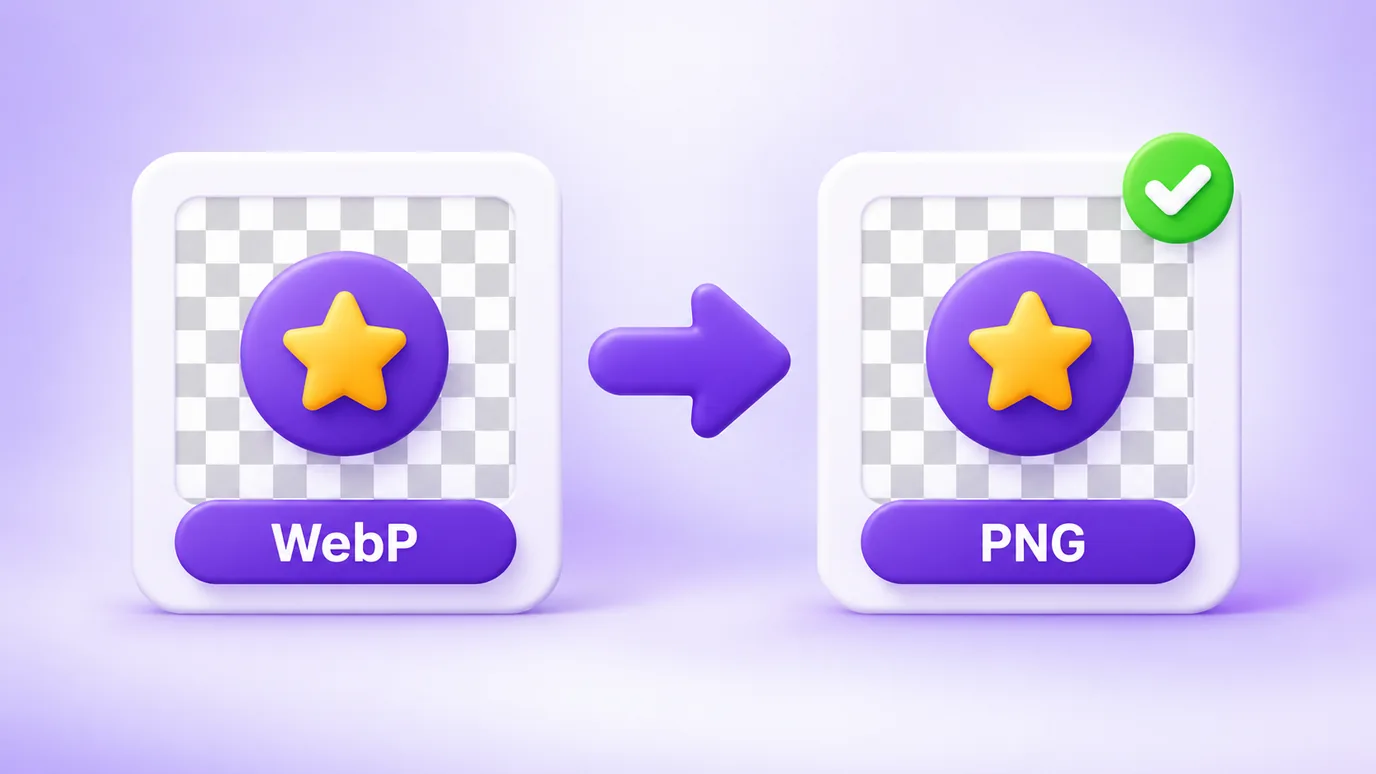
PNG keeps transparency, is stored without any new loss of detail and opens in practically any program. WebP usually produces smaller files, so the resulting PNG tends to be larger.
Converting does not improve the image: if the WebP was lossy, the details it lost stay lost. PNG just stops adding a new loss.
When converting makes sense
- Opening or editing the image in a program that cannot read WebP.
- Keeping the transparency of a logo or icon when using it in a program or platform that asks for PNG.
- Saving an image without applying a new lossy compression every time you edit it.
- Standardizing a set of images in a format that opens anywhere.
What this tool does not do
- It does not increase quality: the PNG has the same detail as the source WebP.
- It does not convert iPhone HEIC photos, GIF, SVG, BMP, TIFF or PDF: it accepts PNG, JPG, WebP and AVIF (AVIF depends on your browser being able to open it).
- It does not keep animations: the result is a still image.
- It is limited by your device memory: up to 30 images at a time, 50 MB per file and 60 megapixels per image.
- It creates a new image without the original file metadata (such as EXIF).
Frequently asked questions about WebP to PNG
How do I convert WebP to PNG?
To convert WebP to PNG, add the image to the tool, check that the output format is PNG and download it. The conversion happens in your browser, without sending the file to a server.
Does converting WebP to PNG keep transparency?
Yes. PNG supports transparency, so the transparent areas of the WebP stay transparent in the PNG.
Why is the PNG larger than the WebP?
Because PNG does not use lossy compression and WebP is usually more efficient. The size appears under "Before" and "After" so you can compare.
Do I lose quality when converting WebP to PNG?
Converting to PNG adds no loss of detail, but it does not recover what the WebP may have already lost if it was lossy.
Why convert WebP to PNG?
To open the image in programs that cannot read WebP, to keep transparency in a format any editor accepts, or to save without a new lossy compression.
Can I convert an animated WebP to PNG?
The result is a still image: the tool does not keep animations.
Can I convert several WebP files to PNG at once?
Yes. You can add up to 30 images at a time, convert them all and download everything in a ZIP.
Is my WebP image uploaded to a server?
No. The WebP to PNG conversion happens in your browser and the file is not sent to any server.
Other image tools
In your browser, without uploading the files, you can also: