Your ecommerce store is generating data all day long.
Every product page someone visits, every category they browse, every form they complete, every purchase they make and every campaign link they arrive from creates a signal about that customer journey.
That data is often called first-party data: information collected directly through a company's own digital properties and customer interactions.
For ecommerce businesses, this data becomes much more valuable when it is organized into meaningful audiences. A retailer can identify customers who buy frequently, visitors who are showing strong purchase intent, shoppers interested in a particular category, or customers who have stopped purchasing after being highly active.
The next step is turning those audiences into action: personalized campaigns, abandoned-cart recovery, cross-selling, loyalty programs, email and WhatsApp automation, or, for larger retailers, audience activation for retail media.
This is where segmentation becomes important.
Micro-segmentation is one layer of that process. It means creating smaller, more specific audiences from observable signals so that each audience can receive a more relevant experience.
Popconvert operates at the capture and on-site activation layer of this ecosystem: it can capture visitor information through interactive experiences, and it uses behavioral, URL and campaign signals to decide when and where a campaign appears.
The real value is not collecting more data. It is being able to turn first-party data into better decisions and more relevant customer experiences.
What Is First-Party Data?
First-party data is information a business collects directly from its own customers and visitors, through its own site, store, forms and campaigns. An ecommerce store generates it through:
- pages visited, products viewed and categories browsed;
- clicks and other interactions;
- forms and leads;
- purchases and order history;
- campaigns and the source of each visit;
- timestamps and events that show when something happened;
- the relationship with the customer, including consent where it applies.
No single tool holds all of this. In practice, a data ecosystem is made of layers, and each layer knows and does something different:
| Layer | Role |
|---|---|
| On-site capture | Popups, forms and interactive campaigns that collect data where visitors interact with the store |
| Ecommerce platform | Transactions, products, orders and customer activity |
| CRM | Customer relationship and communication history |
| CDP | Unifying customer and behavioral data from several sources |
| Analytics | Measurement and behavioral analysis |
| Activation channels | Email, WhatsApp, SMS, on-site experiences, loyalty and advertising |
| Retail media | Audience activation by retailers for brands |
The ecommerce platform may know what was purchased. The CRM may know the customer's communication history. The CDP may unify behavioral and customer data. On-site capture tools add first-party data at the point where visitors interact with the store.
Why First-Party Data Matters to Retailers
A retailer sits in the middle of a chain: brand or manufacturer → retailer → consumer. Because it serves many shoppers, it sees demand directly: which categories people browse, what they buy, how often they come back and what makes them leave.
That is a privileged view of the market, and it explains why first-party data has become so valuable. For larger retailers, this audience intelligence can also become commercially valuable beyond their own ecommerce operation.
This is the idea behind retail media: brands want access to relevant audiences, and retailers hold the behavior and purchase signals that describe them. For large retailers, that can open the door to:
- audience activation for brands;
- sponsored products;
- product launches;
- category campaigns;
- measurement of those campaigns.
You do not need a retail-media network to benefit from first-party data, and this article is not a retail-media guide. It is context for why the data is worth organizing properly, whatever the size of the store.
From Data to Action
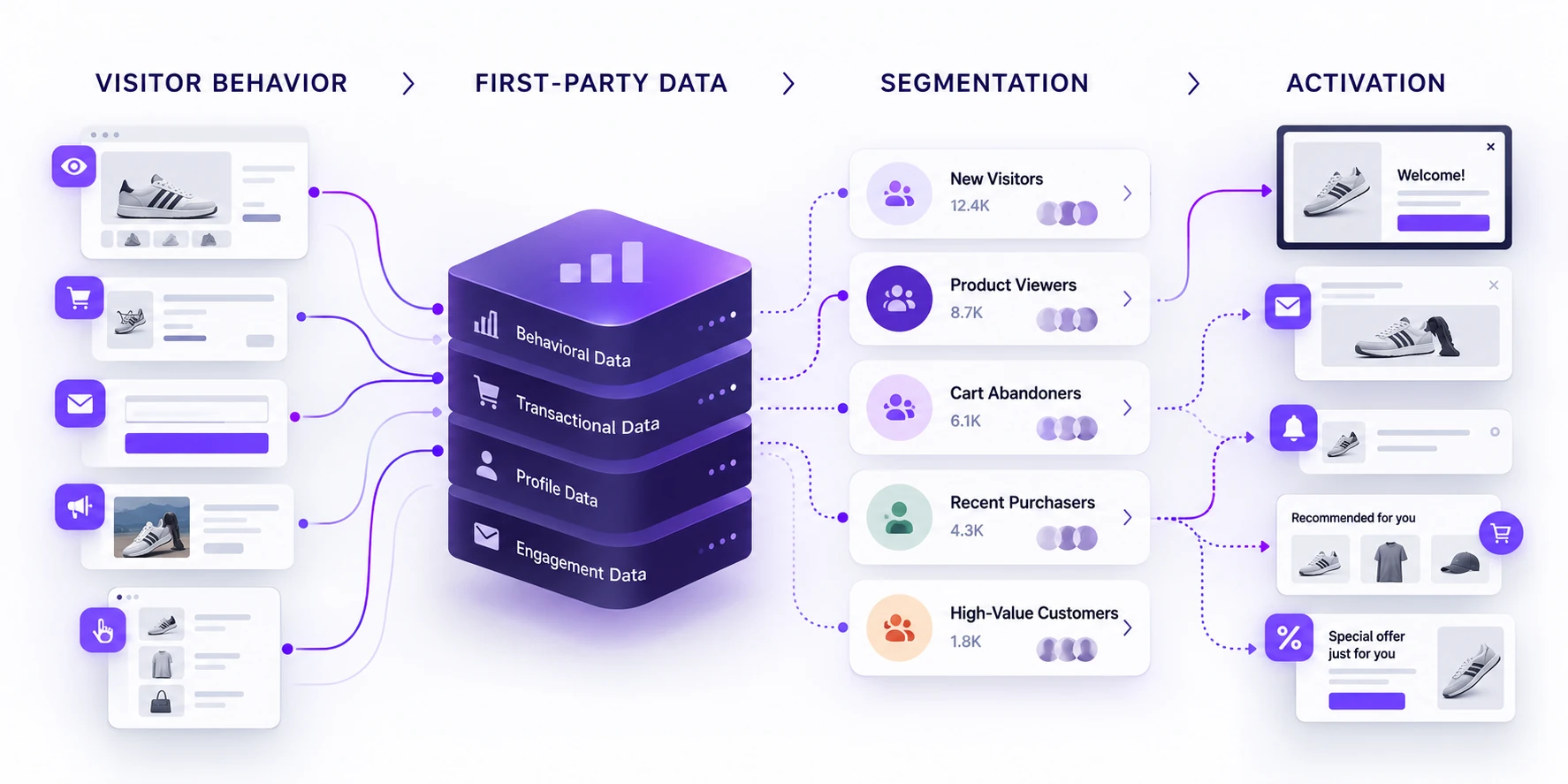
Collected data does nothing on its own. It becomes useful as it moves through five steps:
Capture → Organize → Segment → Activate → Measure
Capture
Data enters through popups, forms, gamified campaigns and the interactions that happen in your store.
Organize
It then needs a home: the ecommerce platform, a CRM, a CDP or an analytics tool, so that a visit, a lead and an order can be understood together.
Segment
Segments can be built from behavior, purchase history, recency, frequency, monetary value and category interest.
Activate
A segment is only useful when something happens to it: an email, a WhatsApp message, an SMS, an on-site campaign, a loyalty reward or an offer.
Measure
Finally, look at orders, revenue, conversion, average order value and engagement, to see which segments and actions actually move the business.
RFM: A Simple Way to Segment Customers
One of the most common ways to segment customers from purchase data is RFM: Recency, Frequency, Monetary. It is a method from ecommerce and CRM practice, not a feature of any single tool.
| Signal | Question |
|---|---|
| Recency | When did they last buy? |
| Frequency | How often do they buy? |
| Monetary | How much do they spend? |
RFM is useful because it moves segmentation away from broad demographic labels and toward what customers actually do. Scoring customers on the three signals produces clusters of customers, such as:
- Champions: RFM models commonly use this name for customers with strong recency, frequency and monetary scores. They can be candidates for loyalty initiatives, early access, exclusive experiences or feedback programs.
- Loyal customers: they buy regularly, even if not at the highest value.
- New customers: a recent first purchase and little history yet.
- At-risk customers: they used to buy often but have gone quiet.
- Lapsed customers: no purchase for a long time.
Group names and thresholds vary between businesses. Treat them as a starting vocabulary, then define what each group means for your own store.
From Customer Segmentation to Micro-Segmentation
Customer segmentation groups people by history and relationship. For example:
Customers who purchased three or more times in the last 12 months.
Micro-segmentation is more specific: it combines signals, including what is happening right now. For example:
Customers who recently purchased running shoes and are currently browsing the accessories category.
The second group is smaller, but it shares a real situation, so a message can speak to it directly. This is why current context can complement customer history: history says who the customer is, and context says what they are doing now.
Finer is not automatically better. Start from a decision, not a data field: ask what you would actually do differently for the group. If the honest answer is "show the same thing," the split is not worth maintaining. For a deeper look at how micro-segments work on a website, see our guide to micro-segmentation in marketing.
Signals Used for Ecommerce Segmentation
Segments are built from signals, and the signals live in different places. That matters, because where a signal lives decides which tool can use it.
Behavioral signals
Pages viewed, scroll depth, time on page, exit intent and other interactions during the visit.
Contextual signals
The URL, the category, the product page and campaign parameters such as UTM or query strings.
Customer signals
Purchase history, recency, frequency, monetary value and loyalty status. These typically live in the ecommerce platform, a CRM or a CDP.
Acquisition signals
The campaign, source, landing page and channel that brought the visit. If campaign links carry no tags, adding them is the first step, because a rule cannot match what an address does not say.
What First-Party Data Can Enable
The examples below show how first-party data can become actionable when different systems work together: typically an ecommerce platform, a CRM or CDP, and email, SMS or WhatsApp tools.
| Use case | What happens |
|---|---|
| Abandoned cart recovery | A visitor adds a product, leaves without buying and receives a message that brings them back to checkout. |
| Product interest | A visitor shows repeated interest in a category, such as mattresses, and receives communication relevant to it. |
| Cross-selling | A customer buys running shoes and receives a recommendation for related products, such as accessories. |
| Loyalty | A customer with high frequency or high value receives a benefit or experience not offered to everyone. |
| Product launches | People interested in a category hear about a relevant launch before the general audience. |
| Re-engagement | A customer who used to be active and has gone quiet receives a reactivation campaign. |
Email Is Only One Activation Channel
Once a segment exists, there are several ways to reach it:
- email;
- WhatsApp;
- SMS;
- on-site experiences;
- loyalty platforms;
- retail media, for larger retailers.
The right channel depends on the business, the consent model, the customer relationship and the economics.
Where Gamified Capture Fits Into a First-Party Data Strategy
A traditional form says: fill out this form. A gamified experience gives the visitor a reason to interact:
Spin the Wheel → participate → provide information → receive a reward.
That interaction becomes an additional first-party data point. It can tell you:
- the information the visitor provides in the form;
- the campaign or experience they interacted with;
- the reward delivered, when applicable.
The fuller purchase journey still comes from the ecommerce platform, the CRM and the other layers above. Tools such as Popconvert can contribute to the capture layer by turning on-site interactions into captured leads.
Gamification is designed to give visitors a stronger reason to interact and share information than a conventional form. Results still depend on the offer, the audience and how much you ask for. For ideas on the reward side, see our guide to spin-the-wheel prize ideas.
Where Popconvert Fits in the First-Party Data Ecosystem
Different tools play different roles in a first-party data strategy. A CRM manages customer relationships and communication, while a CDP can unify customer and behavioral data across sources. On-site capture tools contribute data at the point where visitors interact with the store.
Popconvert fits into this capture layer through interactive campaigns and gamified lead capture. Visitors interact with a campaign, and the leads captured through forms can be exported as CSV or connected to CRM and email tools. Triggers, URL segmentation and display limits control when and where each campaign appears.
Micro-Segmentation With Popconvert
Within that scope, these are the documented ways to narrow who sees a campaign:
- URL rules. Show a campaign only on certain categories or products, or keep it off checkout and thank-you pages. If nothing is configured, a campaign shows across the whole site.
- Campaign and source parameters. Query-based URL rules can match UTM tags and other parameters present in the page URL.
- Browsing behavior. Triggers react to time on the page, scroll, pages visited, exit intent or a specific click.
- New visitors or all traffic. Display Audience offers these two options, next to Replay and Display Frequency.
Conditions in one filter must all be true (AND); separate filters work as OR. URL rules read the address of the page being viewed, so customer-history segments such as RFM come from your ecommerce platform or CRM.
First-Party Data Should Improve the Customer Experience
First-party data can help businesses create more relevant customer experiences when it is collected, connected and used responsibly. It is not valuable simply because it exists.
The objective should not be to send more messages. It should be to send fewer, more relevant ones. A customer who repeatedly browses a product category should not necessarily receive every promotion the store publishes. The value of segmentation is understanding context well enough to make communication more useful.
Collection and use should respect consent, privacy and the data-protection requirements that apply to your business and your market. Behavioral and purchase data can count as personal data when it is, or can be, linked to a person.
FAQ
What is first-party data in ecommerce?
Information a store collects directly from its own visitors and customers through its own site, forms, campaigns and purchases: browsing behavior, leads, order history, interactions and the source of a visit, plus consent where it applies.
Why is first-party data important for ecommerce?
It shows what shoppers actually do in your own store. That lets you build audiences, personalize communication, measure what works and decide which customers should receive which action, without depending on data that someone else collected.
What are examples of first-party data?
Pages and products viewed, items added to the cart, purchases and order history, form submissions and leads, email and campaign interactions, the campaign or channel a visit came from, and preferences customers share with you.
How do ecommerce businesses collect first-party data?
Through the ecommerce platform and analytics (behavior and purchases), forms and popups (leads), email and messaging interactions, loyalty programs and interactive campaigns such as Spin the Wheel, where visitors share details in exchange for a reward. Popconvert is one example of that last category.
How can first-party data be used for customer segmentation?
By grouping customers according to what they do: how recently and how often they buy, how much they spend, which categories they browse and where they came from. Each group can then receive a message or offer that fits its situation.
What is RFM segmentation?
A way to group customers by Recency (when they last bought), Frequency (how often they buy) and Monetary value (how much they spend).
What is micro-segmentation in ecommerce?
Creating smaller, more specific audiences from combined signals, including current context. For example, customers who recently bought running shoes and are now browsing accessories, instead of all customers who bought in the last 30 days.
What is the difference between first-party data and third-party data?
First-party data is collected directly by a business from its own audience. Third-party data is collected by other organizations and then shared or sold. With first-party data you know where it came from and what consent applies, which matters as privacy rules and browsers limit some forms of third-party tracking.
How can first-party data improve ecommerce personalization?
It lets you tailor recommendations, offers, content and timing to what customers actually do and buy, instead of guessing. A customer who buys running shoes can receive accessory suggestions rather than a generic promotion.
How is first-party data used in retail media?
Large retailers use audiences built from their own behavior and purchase data so brands can reach relevant shoppers through sponsored products, category campaigns and product launches, and then measure the results. It needs advertising infrastructure and the right consent, so it mostly concerns larger retailers.
How can businesses use first-party data without becoming intrusive?
Collect only what you will use, respect consent and privacy requirements, and aim to send fewer, more relevant messages rather than more messages. Frequency and relevance matter as much as the data itself.
How does gamification help collect first-party data?
It is designed to give visitors a stronger reason to interact and share information than a conventional form. The interaction itself also becomes a data point. Results still depend on the offer, the audience and how much you ask for.
Ready to Turn First-Party Data Into Action?
Start with one capture point and one clear decision about what you will do with the data. Check out Popconvert's plans or start a free trial to set up your first campaign.